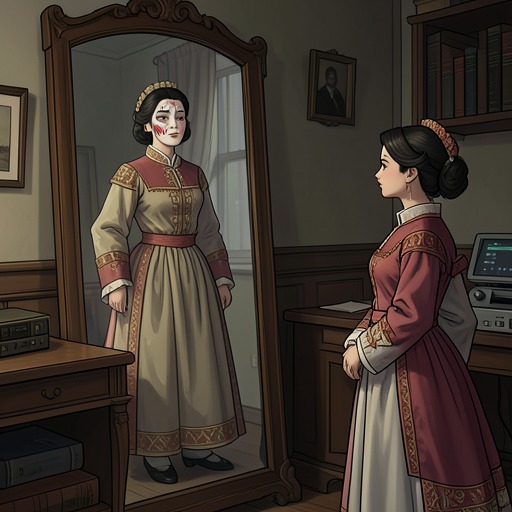
Geisha makeup as transformation
Memoirs of a GeishaGeisha makeup as transformation describes the ritual through which a woman becomes a geisha not only in appearance but also in professional outlook. In Sayuri’s account, the change begins before she can understand its purpose: dressed in a brilliant blue silk kimono, she is warned not to disturb Hatsumomo as Hatsumomo prepares for the day. The scene then turns makeup into a threshold between private morning life and public identity, while the garments and objects surrounding it reveal the material labor that sustains the image.
Identity and the Morning Ritual
Sayuri’s later explanation distinguishes looking like a geisha from becoming one. A geisha waking in the morning is, in most respects, an ordinary woman; the decisive transition occurs as she sits before a mirror and applies her makeup with care. The process changes how she thinks as well as how she looks. Makeup therefore functions as professional practice and mental preparation, not simply as decoration added to an already complete identity.
The distinction is introduced through Hatsumomo’s dressing scene. Before taking Sayuri upstairs, her attendant gives the child a stern warning not to distract Hatsumomo or provoke her. Sayuri does not understand the concern at the time, but her later narration places the warning within the demands of transformation: the private act of preparing requires concentration, and the finished public persona cannot be separated from the disciplined ritual that produces it.
The Making of the Face
Hatsumomo’s routine proceeds in stages. She softens wax between her fingertips and applies it to her face, neck, and chest. She moistens a flat brush, works it through makeup in a dish of water, and spreads the resulting white paste over her face and neck while leaving the eyes and areas around the lips and nose unpainted. Smaller brushes fill those unpainted spaces later. The initial white layer, before its details are completed, resembles a mask; the sequence makes the finished face seem constructed through deliberate, precise work rather than naturally given.
The contrast between transformation and ordinary life carries an emotional cost for the observing child. Sayuri watches Hatsumomo prepare while knowing that soon men will gaze at the completed face, whereas she will remain in the okiya looking plain. Her jealousy and shame register the unequal access to the visible status of geisha: the ritual confers public attention on the woman who performs it, while the child who witnesses it has not yet reached that role.
Neck, Costume, and the Public Image
The makeup extends beyond the face. After blush is applied, Hatsumomo leaves her eyebrows and lips unfinished and asks Auntie to paint the back of her neck. The design, called sanbon-ashi, or three legs, leaves a pattern that frames the visible skin. Sayuri’s retrospective account explains that the exposed nape carried erotic significance for male viewers; a narrow margin of bare skin around the hairline likewise made the white makeup appear artificial, like a Noh mask, and heightened the contrast between painted surface and uncovered skin. The effect depends on artifice being visible: the face is not mistaken for an unmade natural appearance but presented as a carefully composed image.
The kimono and obi complete that composition. Sayuri arrives in her first silk kimono, bright blue with green grasses around the hem and yellow flowers across the sleeves and chest. Hatsumomo’s obi, by contrast, requires more than a simple knot: Mr. Bekku uses cords, clasps, and padding to shape it, taking several minutes to make the heavy fabric lie almost without a wrinkle. Makeup is one part of a larger dressing practice in which the body, clothing, and skilled assistance are arranged together for public appearance.
Objects, Scarcity, and the Work of Appearance
The okiya’s extensive kimono stores reveal the economic weight behind geisha presentation. Sayuri finds cases packed with perhaps fifteen kimono each and understands why Granny fears fire: the collection is worth roughly twice as much as the villages of Yoroido and Senzuru combined. The most expensive garments are kept elsewhere in a rented vault, reserved for apprentice geisha; because Hatsumomo can no longer wear them, they remain in safekeeping until needed again. The transformation into a geisha thus rests on stored, maintained, and allocated objects, not on makeup alone.
Wartime scarcity later changes what such possessions mean. When Sayuri moves her things, she has only a few scrolls, inkstones, bowls, stereoscopic photographs, and a silver viewer given by the Kabuki actor Onoe Yoegoro XVII. Cosmetics and permanents have been banned as luxuries by the military government, although those in Gion continue more or less as before; lavish gifts, however, have become rare. During the war, Mother grows wealthy trading other people’s heirlooms, including kimono sold by Mr. Arashino, which pass through her hands. These later circumstances sharpen the contrast between the resources required to maintain a geisha’s appearance and the shifting availability and circulation of the things that support it.
Significance
The concept joins identity to material practice. A geisha’s public image is made through repeated acts of application, painting, dressing, and arranging, and the ritual also establishes a way of thinking suited to the role. The mask is therefore neither a simple disguise nor an isolated cosmetic effect: it is the visible outcome of training, labor, specialized objects, and social attention.
Sayuri’s account also holds two perspectives in tension. As a child, she sees Hatsumomo’s completed appearance as a source of attention she cannot yet share; as a narrator looking back, she can explain how that appearance is assembled and why the process matters. The shift from envy to explanation turns a dressing scene into an account of how professional identity is made—and of how its polished public surface depends on private preparation and material support.